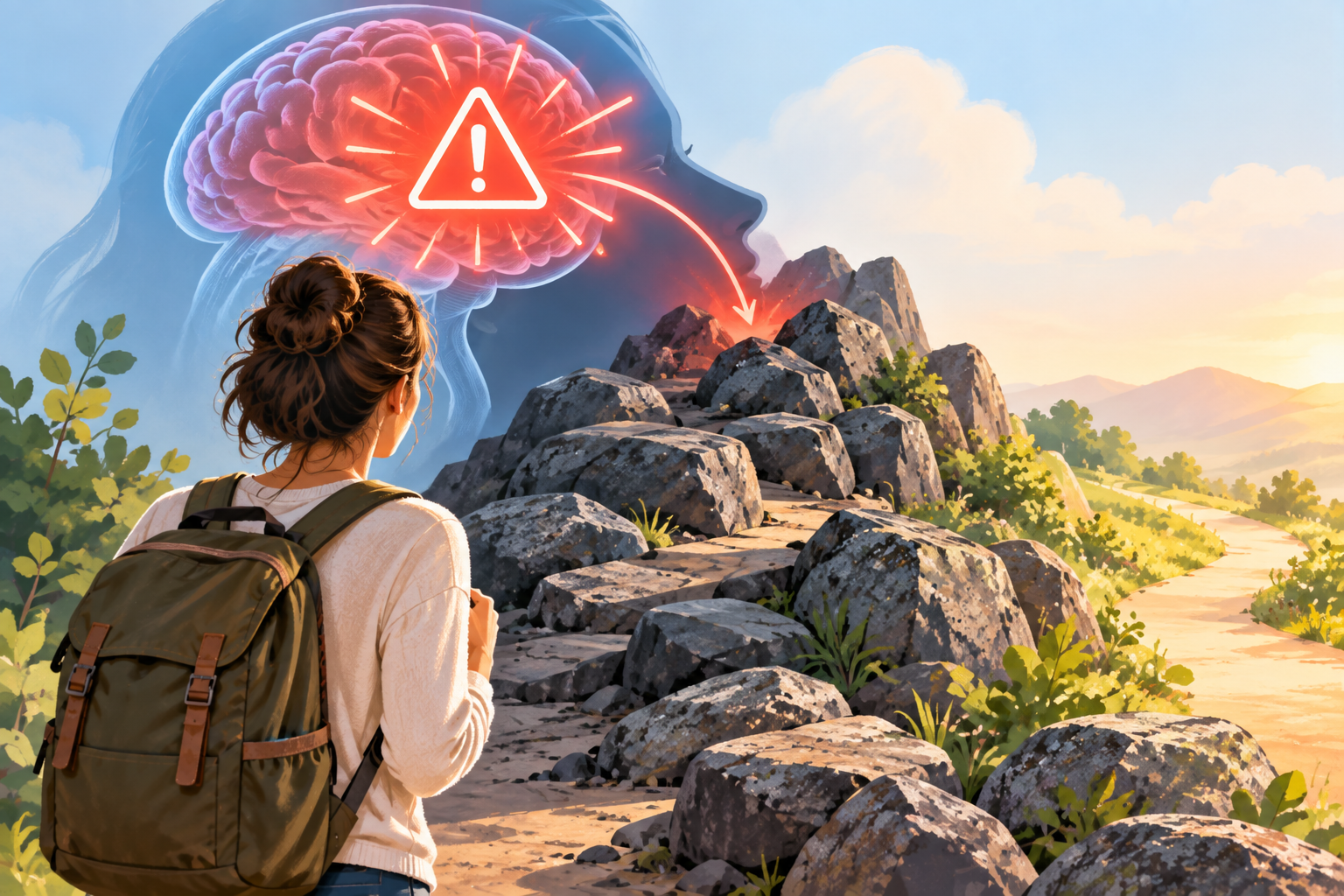
Have you ever noticed how quickly your mind jumps to the worst possible outcome?
A friend doesn’t answer your text, and you wonder if they’re upset with you.
Your spouse says, “Can we talk later?” and your mind immediately imagines divorce.
Your boss schedules a meeting, and before you’ve even walked into the office, you’ve convinced yourself you’re being fired.
A headache becomes a brain tumor.
A cough becomes cancer.
A child running five minutes late becomes a terrible accident.
Before any evidence appears, your mind has already written an entire disaster movie.
If you’ve ever asked yourself, “Why do I always expect the worst?” you’re far from alone. This pattern is one of the most common reasons people seek counseling. It affects individuals struggling with anxiety, PTSD, panic attacks, health anxiety, perfectionism, and chronic stress. It can also appear in people who have lived through significant trauma or simply grown up in unpredictable environments.
The encouraging news is that this pattern does not mean you’re irrational, weak, or broken.
In fact, it often means your brain is trying very hard to protect you.
The problem isn’t that your brain wants to keep you safe.
The problem is that somewhere along the way, it learned that expecting danger was the safest strategy.
Understanding why that happens is the first step toward changing it.

Your Brain Was Built to Notice Danger
One of the greatest misunderstandings about anxiety is believing that our brains are designed primarily to make us happy. While happiness is certainly something we all desire, it is not the brain’s first priority.
Its first priority is survival.
For thousands of years, human beings survived because our ancestors noticed danger quickly. The people who heard rustling in the bushes and assumed it might be a predator were more likely to survive than those who assumed everything was perfectly safe. Our brains evolved to scan constantly for anything that could threaten our well-being.
That survival system still exists today.
The difference is that most of us are no longer worrying about wild animals or hostile environments.
Instead, our brains scan for modern threats:
“What if I lose my job?”
“What if my child gets hurt?”
“What if they leave me?”
“What if I embarrass myself?”
“What if the doctor finds something?”
“What if I make the wrong decision?”
Although these situations feel very different from physical danger, your nervous system often responds as though your survival is still on the line.
Your brain is not trying to predict the future.
It is trying to prevent pain.
Unfortunately, those are not always the same thing.
Anxiety Is a Terrible Fortune Teller
One of anxiety’s favorite tricks is convincing us that possibility and probability are the same thing.
Consider this example.
Is it possible that your flight could crash?
Yes.
Is it probable?
Not even close.
Yet anxiety rarely asks whether something is likely.
Instead, it asks whether something is possible.
If the answer is yes—even by one percent—your brain often begins preparing for it as though it is already happening.
This is why anxious people spend enormous amounts of emotional energy preparing for events that never occur.
They rehearse conversations that don’t happen.
They imagine illnesses they don’t have.
They prepare for rejection that never comes.
They lose sleep over problems that never exist.
Ironically, all of this preparation rarely prevents suffering.
Instead, it creates suffering in advance.
Mark Twain reportedly said,
“I’ve had a lot of worries in my life, most of which never happened.”
Whether or not you’ve heard that quote before, you’ve probably lived it.

Why Worst-Case Thinking Feels Responsible
Many people don’t realize they have become attached to expecting the worst.
In fact, they often believe it is one of the reasons they are successful.
They tell themselves things like:
“If I expect the worst, I’ll be prepared.”
“If I lower my expectations, I won’t be disappointed.”
“If I think through every possibility, nothing will catch me off guard.”
“I’d rather be pleasantly surprised than devastated.”
At first glance, these beliefs seem wise.
Preparation is important.
Planning ahead is healthy.
Thinking through possibilities is often responsible.
The problem occurs when preparation quietly turns into chronic fear.
Instead of helping you solve actual problems, your mind begins inventing hypothetical ones.
Instead of preparing for realistic challenges, you begin rehearsing disasters.
The result is that you spend hours solving problems that never arrive while having less emotional energy available for the life you’re actually living.
Your Brain Thinks It Can Prevent Pain

Have you ever noticed that after imagining the worst-case scenario, you feel compelled to keep thinking about it?
That’s because your brain has learned an important—but inaccurate—lesson.
It believes that worrying is productive.
Every time you mentally rehearse something frightening, your brain tells itself,
“I’m working on this.”
“I’m staying prepared.”
“I’m protecting us.”
The strange part is that worrying rarely produces actual solutions.
Instead, it creates the illusion of control.
Imagine sitting in a rocking chair.
You’re moving constantly.
You’re working hard.
You’re expending energy.
But you’re not actually going anywhere.
That’s exactly what chronic catastrophizing often looks like.
It feels productive because your mind is busy.
But busyness and progress are not the same thing.
Why Some People Automatically Expect the Worst
Not everyone develops this thinking pattern.
Some people naturally assume things will work out.
Others instinctively prepare for disaster.
Why?
Often, the answer has less to do with personality than with experience.
If your life has repeatedly taught you that bad things happen without warning, your brain learns to stay ready.
If you grew up in a home where conflict erupted unexpectedly, your nervous system may have learned to scan constantly for signs that something was about to go wrong.
If you’ve experienced betrayal, illness, abuse, sudden loss, financial hardship, or trauma, expecting the worst may have once helped you survive emotionally.
The brain is remarkably efficient.
Once it discovers a strategy that appears to reduce surprise—even if it increases anxiety—it tends to keep using it.
This means your tendency to expect the worst may not be a character flaw at all.
It may simply be an old survival strategy that has outlived its usefulness.
Recognizing this can be incredibly freeing.
Instead of asking,
“Why am I like this?”
you can begin asking,
“What taught my brain that this was necessary?”
That question opens the door to understanding rather than self-criticism.
The Cost of Always Expecting the Worst

While worst-case thinking feels protective, it often comes with a hidden cost.
It steals joy from good moments because you’re already worrying about how they’ll end.
It makes it difficult to trust people because you’re preparing for betrayal.
It creates distance in relationships because fear keeps you guarded.
It fuels indecision because every choice seems capable of ending in disaster.
It exhausts your mind because you’re constantly solving problems that don’t exist.
Perhaps most painfully, it keeps you living in a future that hasn’t happened while missing the life unfolding right in front of you.
The tragedy isn’t simply that anxious people expect bad things.
It’s that they often miss many of the good things happening today because they’re busy preparing for tomorrow’s imagined disasters.
Where Does This Thinking Come From?
If you’ve spent years expecting the worst, it’s easy to believe that’s simply who you are. You may describe yourself as “a worrier,” “an overthinker,” or someone who has always been pessimistic. While those labels may describe your experience, they rarely explain its origin. Our brains are not born expecting every situation to end in disaster. Instead, they learn from repeated experiences. Every success, disappointment, relationship, trauma, and environment teaches the brain something about the world. Over time, these experiences become mental shortcuts that help us predict what might happen next. If life has consistently taught your brain that painful surprises are common, it makes sense that your mind would begin looking for danger before it appears. This isn’t because your brain wants to make you miserable; it’s because it believes anticipating danger is the safest way to protect you.
Childhood Often Becomes the Blueprint
One of the first places we learn what to expect from life is within our families. Children raised in stable, predictable homes often develop an underlying belief that the world is generally safe, that people can be trusted, and that problems can usually be worked through. While life will still bring challenges, their brains learn that difficulty is temporary rather than constant.
For many people, however, childhood looked very different. Perhaps conflict erupted without warning, a parent struggled with addiction or untreated mental illness, criticism was frequent, or affection felt conditional. Some children grew up constantly wondering what version of a parent would walk through the door each evening. Others learned to monitor facial expressions, tone of voice, or the sound of footsteps because those subtle cues helped them predict whether the next few hours would be peaceful or chaotic. These children weren’t being dramatic—they were learning survival skills.
The remarkable thing about the brain is that it keeps using strategies that once worked. If staying alert protected you as a child, your brain often assumes it should continue staying alert as an adult. Instead of scanning for an angry parent, it begins scanning for an upset spouse, a disappointed boss, or a friend who might be pulling away. The circumstances have changed, but the brain continues using the same prediction system because it believes it is keeping you safe.
Trauma Changes the Way We Estimate Risk
For individuals who have experienced trauma, expecting the worst is often rooted in lived experience rather than imagination. Trauma teaches us something that many people never have to learn firsthand: life can change in an instant. A single phone call, accident, diagnosis, betrayal, or unexpected loss can alter everything we believed about our future. Once the brain has experienced an event like that, it becomes far less willing to dismiss unlikely possibilities.
This is one reason trauma survivors often struggle to relax, even during seasons of peace. While other people may naturally assume tomorrow will look much like today, the traumatized brain remembers that devastating events often arrive without warning. It quietly reasons, “If it happened once, it could happen again.” That belief isn’t a sign of weakness; it’s the nervous system trying to prevent another painful surprise.
This constant state of readiness is known as hypervigilance. Hypervigilance occurs when the brain remains on high alert, continually scanning the environment for signs that something is about to go wrong. Although this response can be lifesaving during genuine danger, it becomes exhausting when it continues long after the threat has passed. The mind begins treating ordinary situations as potential emergencies, making it difficult to fully relax, trust others, or simply enjoy peaceful moments.

Perfectionism Is Often Fear Wearing a Different Name
Many people are surprised to discover that perfectionism and catastrophic thinking are closely connected. On the surface, perfectionism appears to be about high standards or personal excellence. Beneath the surface, however, it is often driven by fear. The perfectionistic mind quietly believes that mistakes lead to rejection, failure, embarrassment, or loss. If every detail can be controlled, perhaps painful outcomes can be avoided.
This belief often develops over many years. Someone who was criticized for mistakes as a child may begin believing that perfection is the only path to acceptance. Another person may believe that if they prepare for every possible problem, nothing bad will catch them by surprise. While careful planning is healthy, perfectionism takes planning far beyond what is helpful. It convinces us that uncertainty itself is dangerous and that every possible outcome must be anticipated before we can feel safe.
The reality is that life has never offered that kind of certainty. No amount of planning can eliminate every unknown, and no level of preparation guarantees that life will unfold exactly as we hope. As long as our sense of safety depends upon perfect control, our minds will continue imagining increasingly catastrophic scenarios whenever uncertainty appears.
Your Brain Collects Evidence for What It Already Believes
Have you ever purchased a new vehicle and suddenly started noticing that same make and model everywhere? The cars didn’t suddenly multiply overnight. Your brain simply began paying attention to something it had previously ignored. Psychologists call this confirmation bias, and it influences much more than the cars we notice on the road.
Once we develop a belief about ourselves or the world, our brains naturally begin gathering evidence that supports it while quietly overlooking evidence that challenges it. If your mind believes that bad things are always around the corner, it becomes remarkably skilled at finding examples that reinforce that belief. A difficult conversation, an unexpected expense, a medical scare, or a disappointing relationship quickly become proof that your fears were justified.
Meanwhile, countless ordinary moments pass by unnoticed. Safe drives home from work, healthy medical appointments, supportive friendships, answered prayers, successful projects, and peaceful evenings rarely receive the same attention because they don’t fit the story the anxious brain is telling. It’s as though anxiety keeps two journals. One is labeled “Evidence That Life Is Dangerous,” and the other is labeled “Evidence That Life Is Safe.” Unfortunately, it spends most of its time writing in only one of them.
Anxiety Underestimates Your Ability to Cope
Perhaps the greatest distortion anxiety creates isn’t simply overestimating danger—it’s underestimating you. When your mind imagines a worst-case scenario, it usually tells an incomplete story. It vividly imagines losing the job but never imagines updating your résumé, reaching out to professional contacts, or finding another opportunity. It imagines rejection but ignores the friends, family, and support systems that would help you heal. It imagines illness without considering modern medicine, resilience, or your ability to adapt.

Anxiety writes stories where something terrible happens, and then the movie abruptly ends. Reality rarely works that way. Human beings are remarkably resilient. Think about the challenges you’ve already survived—situations that once seemed impossible but somehow became part of your story. You adapted. You learned. You found strength you didn’t know you possessed. Yet anxiety continues treating you as though you are helpless in the face of future uncertainty.
One of the most transformative shifts people make in therapy is moving away from the question, “How can I make sure nothing bad ever happens?” toward a much healthier question: “If something difficult did happen, could I trust myself—and trust God—to help me through it?” That subtle shift changes everything. Peace is not found by eliminating uncertainty. Peace is found by growing confidence that, whatever tomorrow holds, you will not face it alone.
The Hidden Cost of Living in Tomorrow
People who constantly expect the worst often believe they are preparing for the future. In reality, they are frequently sacrificing the present. Instead of enjoying dinner with their family, they are mentally rehearsing tomorrow’s meeting. Instead of celebrating good health, they are worrying about the next medical test. Instead of laughing with friends, they are wondering how long the happiness will last before something goes wrong.
This is one of anxiety’s greatest costs. It convinces us that by emotionally living in tomorrow, we are somehow protecting ourselves today. Yet the future remains unwritten while today’s moments quietly pass by unnoticed. The tragedy isn’t simply that anxious people imagine bad things happening. It’s that they often miss the very life they are trying so hard to protect because their minds are already living somewhere else.
How Do You Stop Expecting the Worst?

The good news is that while your brain learned to expect the worst, it can also learn a different way of responding. The same nervous system that became conditioned to scan for danger is capable of developing new patterns over time. This doesn’t happen by simply telling yourself to “think positive.” If changing lifelong patterns were that easy, anxiety would disappear overnight. Instead, lasting change comes from teaching your brain that uncertainty does not automatically equal danger and that you are more capable of handling life’s challenges than anxiety has led you to believe.
One of the first steps is learning to slow down your thinking long enough to recognize when your mind has shifted from possibility to probability. Anxiety rarely announces itself by saying, “I’m imagining the worst.” Instead, it presents catastrophic thoughts as facts. A delayed text message becomes evidence that someone is angry. A minor mistake at work becomes proof you’ll lose your job. A headache suddenly means something life-threatening is happening. Before reacting, pause and ask yourself, “Is this the most likely outcome, or simply one possible outcome?” That single question interrupts the automatic nature of catastrophizing and gives your logical brain an opportunity to reengage.
Cognitive Behavioral Therapy (CBT) often teaches people to examine three possibilities rather than one. Instead of focusing only on the worst-case scenario, ask yourself three questions: What is the worst that could happen? What is the best that could happen? What is the most likely thing to happen? Most anxious minds spend nearly all of their time rehearsing the first question while completely ignoring the other two. Expanding your thinking doesn’t mean pretending bad things never happen. It means allowing your mind to consider the full range of possibilities rather than becoming trapped by only one.
Learn to Tolerate Uncertainty Instead of Eliminating It
One of the biggest misconceptions about anxiety recovery is believing the goal is to become certain about everything. In reality, certainty is something none of us can ever fully achieve. We cannot guarantee our health, our relationships, our careers, or tomorrow’s circumstances. The anxious brain desperately searches for certainty because it believes certainty creates safety. Unfortunately, the more certainty we demand, the more anxious we often become because life refuses to provide it.
Healing begins when we stop chasing certainty and start increasing our tolerance for uncertainty. This might mean resisting the urge to repeatedly Google symptoms, asking your spouse for reassurance one less time, or allowing yourself to make a decision without researching every possible outcome for hours. These small moments feel uncomfortable because your brain has learned to associate uncertainty with danger. Yet each time you allow uncertainty to exist without immediately trying to eliminate it, you teach your nervous system an important lesson: uncertainty is uncomfortable, but it is not necessarily unsafe.
Over time, your confidence grows—not because life has become more predictable, but because you begin trusting your ability to handle whatever comes. The goal is not to become fearless. The goal is to become less controlled by fear.
Remember That Your Thoughts Are Not Prophecies
One of anxiety’s greatest deceptions is convincing us that thinking about something somehow makes it more likely to happen. People often believe that if they imagine enough possible disasters, they will be emotionally prepared should one occur. Unfortunately, the opposite is usually true. Rehearsing catastrophe over and over again trains the brain to remain in a constant state of alarm, even when life is going well.
A helpful reminder is that thoughts are mental events, not predictions. Every day your brain produces thousands of thoughts, many of which are inaccurate, exaggerated, or completely unhelpful. The fact that you have a thought does not make it true any more than dreaming about falling means you are actually falling. Learning to observe your thoughts without automatically believing them is one of the most powerful skills you can develop.
Rather than arguing with every anxious thought, practice noticing it with curiosity. You might say to yourself, “There’s my brain trying to protect me again,” or “I’m having the thought that something terrible is going to happen.” This small change in language creates distance between you and the thought, reminding you that you are the observer of your thoughts—not their prisoner.
What Does the Bible Say About Fear and Worry?
Many Christians carry an additional burden when struggling with anxiety because they assume their fear reflects weak faith. Reading verses such as “Do not be anxious about anything” (Philippians 4:6) can sometimes leave people feeling guilty, as though anxiety itself is evidence that they have somehow failed spiritually. Yet throughout Scripture we see faithful men and women who experienced fear, uncertainty, grief, and overwhelming circumstances.
The Bible does not ignore anxiety; it consistently redirects it. Again and again, God invites His people to bring their fears to Him rather than carry them alone. First Peter 5:7 reminds us to “Cast all your anxiety on Him because He cares for you.” That invitation assumes we will have anxieties to cast. God is not surprised by our fears, nor does He wait for us to eliminate them before extending His grace.
Jesus Himself addressed our tendency to live in imagined futures. In Matthew 6, He reminds His followers that worrying cannot add a single hour to life. Instead, He invites them to focus on today’s responsibilities while trusting God with tomorrow. This isn’t a call to ignore problems or avoid planning. It is a reminder that our minds were never designed to live in tomorrow before tomorrow arrives.
Faith is not believing that nothing difficult will ever happen. Faith is trusting that God will be present if it does.

When Is It Time to Seek Professional Counseling?
Occasionally expecting the worst is part of being human. However, if catastrophic thinking has become your default response, interferes with your relationships, keeps you awake at night, causes constant reassurance seeking, leads to avoidance, or leaves you emotionally exhausted, it may be time to seek professional support.
Counseling can help you understand why your brain learned to expect danger and provide practical tools for changing those patterns. Through approaches such as Cognitive Behavioral Therapy, clients learn to identify catastrophic thinking, challenge distorted beliefs, strengthen emotional regulation, and gradually build confidence in tolerating uncertainty. For individuals whose worst-case thinking is connected to trauma, therapy also provides a safe place to process painful experiences that continue influencing present-day reactions.
Seeking counseling is not an admission that you are failing. It is an acknowledgment that your brain has been working overtime to protect you and deserves help learning a healthier way forward.
There Is Hope Beyond Catastrophic Thinking
If you’ve spent years expecting the worst, it may feel as though your brain has become wired that way forever. Thankfully, that isn’t how the brain works. Our minds are remarkably adaptable. The same brain that learned to anticipate danger can learn to recognize safety. The same nervous system that became conditioned by fear can gradually become conditioned by truth, practice, and repeated experiences of security.
The goal is not to eliminate every anxious thought. The goal is to stop allowing those thoughts to make your decisions. You may still notice your mind imagining worst-case scenarios from time to time, but those thoughts no longer have to determine how you live. Instead of asking, “What if everything goes wrong?” you can begin asking, “What if I’m stronger than anxiety has led me to believe?”
The future has always contained uncertainty. It always will. But uncertainty is not your enemy. Often, it is simply the place where courage grows, faith deepens, and healing begins.
Ready to Stop Letting Fear Predict Your Future?
At Eternal Hope Christian Counseling, we help children, teens, adults, couples, and first responders understand why their minds have become stuck in patterns of fear, worry, and catastrophic thinking. Through evidence-based approaches such as Cognitive Behavioral Therapy, trauma-informed care, and Christian counseling, we help clients retrain anxious thought patterns, build emotional resilience, and develop confidence in facing uncertainty.
If you’re tired of letting worst-case scenarios steal today’s peace, we’d be honored to walk alongside you as you move toward lasting hope and healing.
Frequently Asked Questions
Is expecting the worst a symptom of anxiety?
It can be. Constantly anticipating negative outcomes is one of the hallmark features of many anxiety disorders, including Generalized Anxiety Disorder (GAD), health anxiety, panic disorder, obsessive-compulsive disorder (OCD), and post-traumatic stress disorder (PTSD).
Why does my mind always jump to the worst-case scenario?
Your brain is designed to detect potential danger. If you’ve experienced trauma, chronic stress, or unpredictable life events, your brain may have learned to overestimate danger as a way of trying to protect you.
Can catastrophic thinking be changed?
Yes. Research consistently shows that approaches such as Cognitive Behavioral Therapy can help individuals recognize and challenge catastrophic thinking while developing healthier ways of responding to uncertainty.
Does expecting the worst mean I’m being realistic?
Not necessarily. Healthy realism considers both risks and possibilities. Catastrophic thinking focuses almost exclusively on negative possibilities while ignoring evidence, probability, and your ability to cope.
Why do I still expect the worst even when things are going well?
Because your brain is responding to patterns it learned in the past, not necessarily to what is happening in the present. Anxiety often remains active until the brain gradually learns that it no longer needs to stay in constant survival mode.
RELATED ARTICLES AND INTERNAL LINKS
Why Your Mind Gets Stuck in the Anxiety Cycle
Why Am I Always Overthinking? Breaking Free from Constant Worry
How to Overcome Anxiety: Understanding the Causes and Finding Healing
Disclaimer
This article is intended for educational purposes only and should not be considered a substitute for professional mental health treatment, medical advice, diagnosis, or individualized counseling. If anxiety, panic, or catastrophic thinking is significantly affecting your daily life, relationships, or ability to function, consider reaching out to a licensed mental health professional. If you are experiencing thoughts of harming yourself or others, call 911, go to your nearest emergency department, or call or text 988, the Suicide & Crisis Lifeline.